
Solidity Library
The Nox library is the developer-facing Solidity SDK for building confidential smart contracts. It provides type-safe wrappers around encrypted values, handles proof validation, manages access control, and triggers off-chain TEE computation, all through a single import.
Quick Overview
import {Nox, euint256, externalEuint256} from "@iexec-nox/nox-protocol-contracts/contracts/sdk/Nox.sol";

contract ConfidentialVault {
    mapping(address => euint256) private _balances;

    function deposit(externalEuint256 encryptedAmount, bytes calldata proof) external {
        euint256 amount = Nox.fromExternal(encryptedAmount, proof);
        euint256 balance = _balances[msg.sender];

        if (!Nox.isInitialized(balance)) {
            balance = Nox.toEuint256(0);
            Nox.allowThis(balance);
        }

        euint256 newBalance = Nox.add(balance, amount);
        Nox.allowThis(newBalance);
        Nox.allow(newBalance, msg.sender);
        _balances[msg.sender] = newBalance;
    }
}
Confidential Functions
The Nox library organizes its functions into three layers, each building on the previous one.
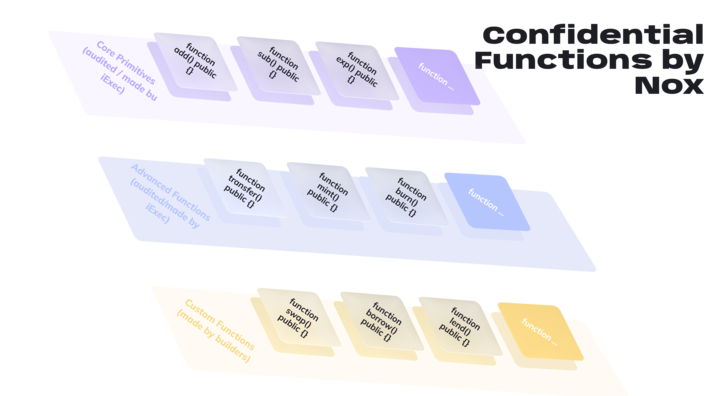
Core Primitives
The foundational building blocks for confidential computation. These low-level operations let you perform arithmetic, comparisons, and conditional logic directly on encrypted values.
- Plaintext to Encrypted: convert plaintext values to encrypted handles
- fromExternal: validate user-submitted handles with EIP-712 proofs
- Arithmetic:
add,sub,mul,divwith wrapping semantics - Safe Arithmetic:
safeAdd,safeSub,safeMul,safeDivwith overflow detection - Comparisons:
eq,ne,lt,le,gt,gereturningebool - select: encrypted conditional branching
- Access Control:
allow,allowThis,addViewer,allowPublicDecryptionand more
Advanced Functions
Higher-level operations composed from core primitives. These provide ready-to-use logic for common DeFi patterns with built-in safety guarantees (all-or-nothing semantics).
- Token Operations:
transfer,mint,burnfor confidential token contracts
Custom Functions
Coming Soon
Developers will be able to define their own confidential functions (e.g. swap, borrow, repay) by composing core primitives and advanced functions into custom on-chain logic executed inside TEEs.
Next Steps
- Getting Started: installation and project setup