
Global Architecture Overview
Nox is a confidential computation protocol for DeFi. It allows smart contracts to operate on encrypted data without ever exposing plaintext on-chain. The protocol coordinates six components: on-chain smart contracts, an event listener (Ingestor), a message queue (NATS), a computation engine (Runner), an encrypted data store (Handle Gateway), and a key management service (KMS).
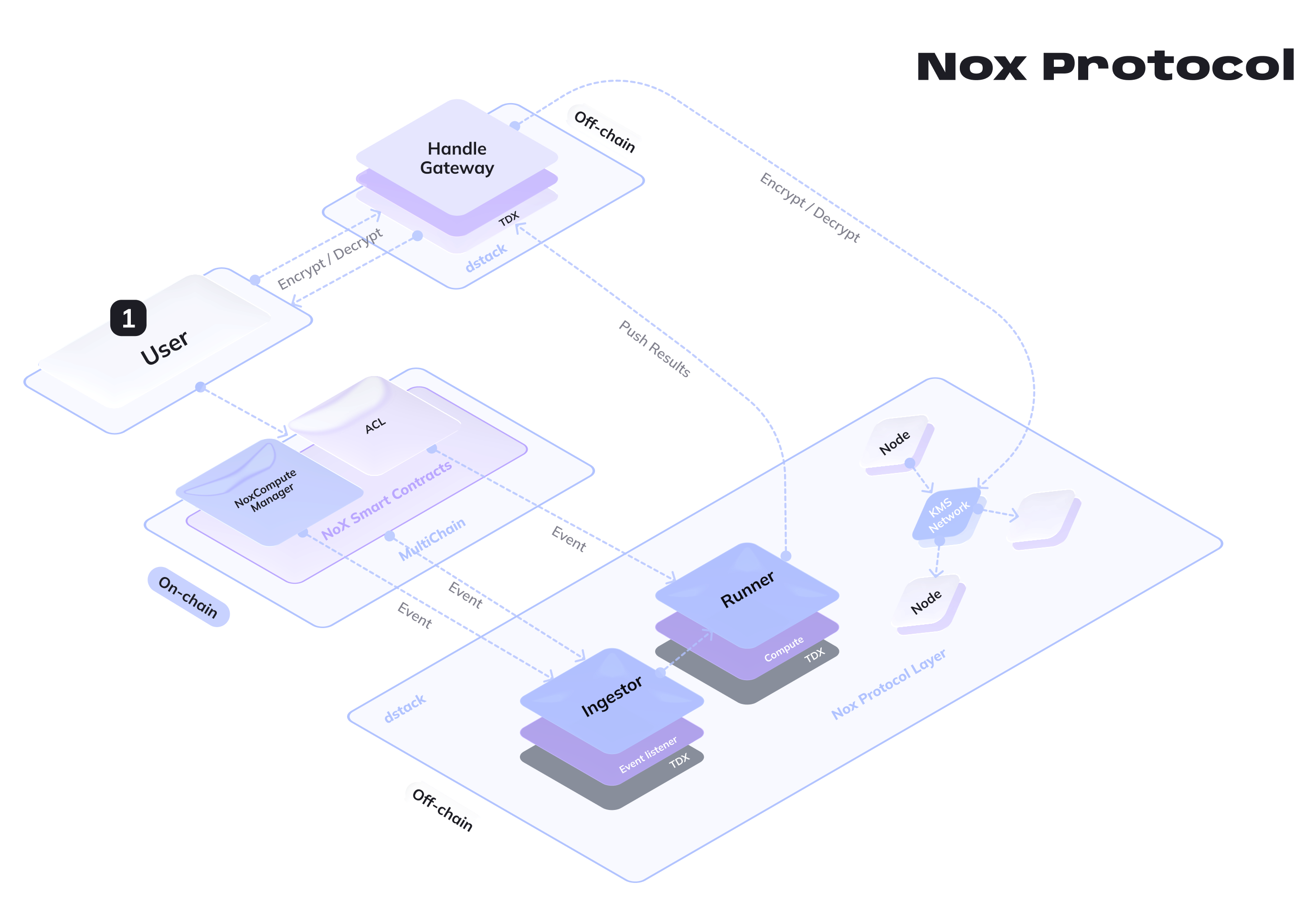
End-to-End Flow
A confidential computation in Nox follows three phases: input, compute, and output. The diagram below shows the complete lifecycle of an encrypted operation, from user input to result retrieval.
Phase 1: Input
The user encrypts sensitive data off-chain and submits it to a smart contract using opaque handles (32-byte identifiers that reference the encrypted data stored in the Handle Gateway).
- The user sends a plaintext value to the Handle Gateway via the SDK
- The Handle Gateway encrypts it with ECIES using the KMS public key and stores the ciphertext in an AWS S3 bucket.
- The Handle Gateway returns a handle and an EIP-712 signed proof attesting the handle's validity.
- The user calls a function on a smart contract that uses the NoxCompute library (e.g.
Nox.add(handleA, handleB)) - NoxCompute validates handle proofs and type compatibility, computes a deterministic result handle, grants transient ACL access on it, and emits an event containing the input and output handles.
At this point, the on-chain transaction is complete. The encrypted result does not exist yet: it will be computed off-chain.
Phase 2: Compute
The off-chain pipeline picks up the event and executes the computation inside a secure environment.
- The Ingestor polls new blocks from the blockchain RPC, filters NoxCompute logs, groups events by transaction, and publishes a
TransactionMessageto NATS JetStream. - The Runner pulls the next message from the queue.
- The Runner requests the encrypted operands from the Handle Gateway, providing an ephemeral RSA public key.
- The Handle Gateway retrieves the object from its AWS S3 bucket and coordinates with the KMS to perform decryption delegation: the KMS computes the ECDH shared secret and encrypts it with the Runner's RSA key.
- The Runner decrypts the inputs locally (RSA decrypt the shared secret, HKDF key derivation, AES-GCM decrypt), executes the computation, and encrypts the result with ECIES using the KMS public key.
- The Runner submits the encrypted result to the Handle Gateway and acknowledges the
TransactionMessagereceived from NATS JetStream.
Phase 3: Output
When the user wants to read a result, the protocol performs decryption delegation so that only the authorized user can recover the plaintext.
- The user generates an ephemeral RSA keypair and sends a decryption request to the Handle Gateway, authenticated with an EIP-712 signature.
- The Handle Gateway verifies the signature and checks the on-chain ACL to confirm the user has viewer permission on the handle.
- The Handle Gateway requests decryption delegation from the KMS: the KMS computes the shared secret and encrypts it with the user's RSA public key
- The user receives the ciphertext, encrypted shared secret, and nonce, then decrypts locally: RSA decrypt the shared secret, derive the AES key via HKDF, and AES-GCM decrypt the ciphertext
The KMS never sees plaintext data. Only the final recipient (user or Runner) performs the actual decryption.
Handles
A handle is a 32-byte identifier that references an encrypted value stored in the Handle Gateway. It does not contain the ciphertext itself.
[0---------------------25]   [26------29]   [30]   [31]
prehandle (26 bytes) Chain ID Type Version| Segment | Size | Description |
|---|---|---|
| Prehandle | 26 bytes | Truncated keccak256 hash (deterministic for computation results, random for user inputs) |
| Chain ID | 4 bytes | Binds the handle to a specific blockchain |
| Type | 1 byte | Solidity type of the encrypted value (uint8, bool, address, etc.) |
| Version | 1 byte | Handle format version (currently 0x00) |
For computation results, the prehandle is derived from the operator, input handles, contract address, caller, timestamp, and output index. This makes handles deterministic: the same operation on the same inputs in the same transaction always produces the same handle.
For user inputs created via the Handle Gateway, the prehandle is a random value. The handle is validated on-chain via an EIP-712 signed proof from the Handle Gateway.
For the full handle specification, see Nox Smart Contracts.
Access Control
The ACL contract manages who can use a handle as a computation input and who can decrypt the underlying data.
| Permission | Granted by | Capability |
|---|---|---|
| Admin | ACL.allow() | Use handle as computation input, manage permissions |
| Transient | NoxCompute (automatic) | One-time use within the current transaction, cleared after |
| Viewer | ACL.addViewer() | Decrypt the associated data via the Handle Gateway |
| Public | ACL.allowPublicDecryption() | Anyone can decrypt |
When NoxCompute creates a result handle, it automatically grants transient access to the calling contract. The contract must persist this permission with ACL.allow() if the handle needs to be used in subsequent transactions.
The Handle Gateway checks ACL permissions on-chain (via isViewer) before serving decryption material to a user.
Encryption
All encrypted data in Nox is protected with ECIES (Elliptic Curve Integrated Encryption Scheme) on secp256k1, using the KMS public key as the encryption target.
The KMS holds the corresponding private key but never decrypts data directly. Instead, it performs decryption delegation: it computes the ECDH shared secret and encrypts it with the requester's RSA public key. The requester then derives the AES key locally and decrypts the ciphertext.
For the full cryptographic protocol, see KMS.
Learn More
- KMS: cryptographic protocol and decryption delegation
- Runner: computation engine and supported operations
- Handle Gateway: encryption, storage, and API reference
- Ingestor: blockchain monitoring and event pipeline
- Nox Smart Contracts: on-chain contracts, handle structure, and ACL
- Solidity Library: full reference of all operations
- Protocol Vision: long-term architecture and design principles